Burst pipe, no heat or no hot water? Call our 24-hour emergency line: 785-776-5548
Heating

Heat you can rely on when the wind comes off the prairie

Winter may be on the way out when you read this, but it will be back before you know it — which makes any month that is not January the right month to evaluate your heating system honestly.

We service and replace gas and propane furnaces, hot water boilers, hydronic loops and radiant systems, and the electric strip heat that backs up a heat pump. Where a system is shared between heating and cooling, we look at the whole thing rather than half of it.

Every furnace or boiler we touch gets a combustion analysis and a carbon monoxide check before we leave. Not on request, not for an extra fee — every time. A cracked heat exchanger is the one failure mode in this trade that can hurt somebody.

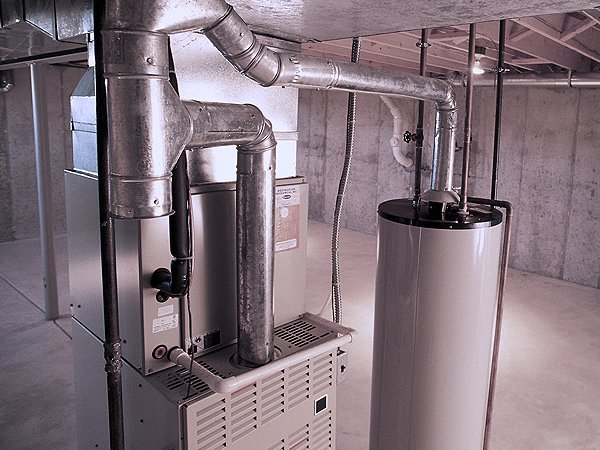
Residential furnace and water heater in a basement mechanical room
What is included

Heating & Furnaces: the full scope

Four areas of work under this heading. Most calls fall into one; larger projects touch several.

Furnace repair

No-heat calls are our busiest winter work. A large share come down to a handful of components, and our trucks carry them: igniters, flame sensors, pressure switches, inducer motors and control boards.

  • Hot surface igniter and flame sensor
  • Pressure switch and inducer faults
  • Limit switch and control board diagnosis
  • Blower motor and capacitor replacement
  • Condensate blockage on high-efficiency units
  • Gas valve testing and replacement

Boilers and hydronic systems

Hot water heat is quiet, even and comfortable, and Manhattan has plenty of it in older homes. It also needs a technician who understands circulators, zone valves, expansion and air elimination.

  • Boiler service and replacement
  • Circulator pump and zone valve repair
  • Expansion tank and air elimination
  • Radiator and baseboard balancing
  • Low water cutoff testing
  • Glycol systems and freeze protection

Replacement and upgrades

When a system reaches the end, replacement is a chance to fix what was wrong from the start: undersized returns, leaking ducts and a system chosen because it matched the old one.

  • Manual J load calculation
  • 90%+ AFUE condensing furnaces
  • Two-stage and modulating equipment
  • Duct and return air corrections
  • Venting evaluated and brought to code
  • Dual-fuel heat pump pairing

Safety testing

Combustion analysis puts numbers on what a visual inspection can only guess at: oxygen, carbon monoxide in the flue, stack temperature and draft.

  • Flue gas combustion analysis
  • Ambient carbon monoxide measurement
  • Heat exchanger inspection
  • Draft and venting verification
  • Gas pressure and manifold check
  • Written report you keep
Know the symptoms

Warning signs worth acting on

Recognising these early is usually the difference between a service call and a replacement.

The furnace starts, runs briefly, then shuts down

Short-cycling on a limit. Most often a dirty filter or a closed return starving the blower, but it can equally be a failing limit switch or an oversized furnace.

A yellow, lazy burner flame

A gas flame should be crisp and blue. Yellow and wavering means incomplete combustion — a combustion analysis, not guesswork, is the next step.

Rooms that never reach the set temperature

Duct leakage, insufficient return air, or a balancing problem. Measuring static pressure tells us which, usually in under an hour.

A burning smell that does not clear

Dust on the exchanger in October is normal and passes within an hour. A persistent smell of hot metal or electrical insulation is not — switch the system off.

The carbon monoxide alarm sounds

Leave the building and call the fire department. Once it is clear, call us for a combustion test before running the system again. Treat every alarm as real.

Water pooling near a high-efficiency furnace

Condensing furnaces produce acidic condensate. A blocked trap or line backs that up into the unit and corrodes it from the inside.

Budget guidance

What this work typically costs

Real invoiced ranges for the Manhattan area. Every job is quoted before we start, and you approve the figure before a tool comes out of the van.

WorkTypical rangeNotes
Furnace tune-up with combustion analysis$119 – $189Included twice yearly on the $119 service agreement
No-heat diagnostic call$95 – $145Trip plus first hour on site
Flame sensor or igniter replacement$170 – $360Parts stocked on the trucks
Inducer or blower motor$480 – $920Varies by model and availability
Control board replacement$420 – $850Manufacturer-specific
Gas furnace replacement, 80% AFUE$3,400 – $5,400Installed with permit and commissioning
Gas furnace replacement, 95%+ AFUE$4,600 – $6,900Includes new venting and condensate
Boiler replacement$6,200 – $13,500Depends on capacity and zone configuration

Ranges are indicative and assume normal access during business hours. Emergency and after-hours work carries a premium rate, confirmed with you before dispatch.

Questions

About heating and furnaces

A well-maintained gas furnace generally runs 18 to 25 years here. Equipment that has never been serviced tends to land at the low end. Past twenty years, we start including a replacement figure alongside any significant repair quote so you can compare the two properly.

The heat exchanger is the metal barrier between combustion gases and the air you breathe. A crack lets flue products — including carbon monoxide — into the supply air. It is not repairable; the exchanger or the furnace has to be replaced, and the system should not be run in the meantime.

Generally no. Forced-air systems are balanced for a designed airflow. Closing registers raises static pressure across the whole system, which reduces airflow over the heat exchanger and can trip limits or shorten blower life. If a room genuinely does not need heat, the answer is zoning, not closed vents.

Usually, though it depends on how long you plan to stay and what your gas rate looks like. A condensing furnace also needs PVC venting and a condensate drain, which adds installation cost in some houses. We quote both and show the annual difference rather than asserting one is better.

Probably not. Heat pump supply air is typically 90–100 °F — warm, but cooler than your skin, so it can feel cool at the register. What matters is whether the house holds its set temperature and whether auxiliary heat is running more than it should. If the auxiliary light is on constantly, call us.

While you are here

Other services we provide

Air Conditioning

Air Conditioning

Installation, repair and replacement of central air, heat pumps and ductless mini-splits — sized correctly and tested before we leave.

Read more
General Plumbing

General Plumbing

Everything from a dripping faucet to a full repipe, backed by 24-hour emergency response for the Manhattan area.

Read more
Water Heaters

Water Heaters

Tank, tankless and hybrid heat-pump water heaters — supplied, installed to code and flushed on schedule.

Read more
Customer feedback

What people say about this work

“Our AC quit on the hottest Saturday of the year. Henton had somebody at the house within two hours, found a failed run capacitor and had us cold again before dinner. No drama, no upsell.”

Dana R.Manhattan, KS

“They replaced a 24-year-old furnace and added a return duct we badly needed. The crew laid down drop cloths in every room they walked through and hauled the old unit away the same afternoon.”

Mark & Julie T.Wamego, KS

“Main line backed up into the basement on a Sunday. The technician cabled it, then ran a camera and showed me the root intrusion on screen so I could actually see what I was paying to fix.”

Priya S.Manhattan, KS

“I have used Henton for both of my rental properties for six years. They quote a range up front, call when they are running late, and the invoice always matches what we discussed.”

Greg H.St. George, KS

“The yearly service agreement is the best money I spend on this house. Two visits a year, and they caught a cracked heat exchanger before it became a carbon monoxide problem.”

Ellen W.Manhattan, KS

“Tankless install in a 1940s house with tight venting. They took the time to do it right instead of talking me into something easier for them. Hot water has been flawless for two years.”

Tomas L.Riley, KS

Need a technician today?

Call the office before 3 pm on a weekday and we can usually be at your door the same day. After hours, the emergency line is answered by a real person.

We use a small number of cookies. They keep the site working and help us understand which pages people find useful. Read the Cookie Policy for the full list.