Freeze-Proofing a Kansas Home: How Pipes Burst and How to Stop It
12 min read Henton Plumbing & Air Conditioning, Inc.
Pipes rarely split where the ice forms. Understanding that one fact changes how you protect a house — and what you do in the first ten minutes after a line freezes.
The thing most people get wrong about burst pipes
Ask ten homeowners why a frozen pipe bursts and nine will say the ice expands and splits the pipe. It is a reasonable guess, and it is wrong — which matters, because the correct explanation changes what you do about it.
Water does expand by about nine per cent when it freezes. But ice forms as a plug at the coldest point, and that plug does not push outward hard enough to split copper. What happens instead is this: the plug seals the pipe completely, and as more water freezes behind it, pressure builds in the trapped column of liquid water between the ice plug and the closed faucet downstream. Water is nearly incompressible, so that pressure climbs fast — often past 2,000 psi.
The pipe then fails at its weakest point in that trapped section, which is frequently several feet away from the ice, in a warm part of the house. That is why a pipe that froze in a crawl space bursts in a wall on the far side of the room.
The practical consequence
If you open the downstream faucet, the trapped column has somewhere to go and pressure cannot build. A pipe that is frozen but open at one end will usually thaw without bursting. This single fact is the most useful thing in this article.
Where Kansas houses freeze
Freezes cluster in predictable places, and they are nearly always where a water line passes through unconditioned space or against an uninsulated exterior surface.
Outdoor hose bibs — by a wide margin the most common. A hose left connected in autumn traps water in the bib, which then freezes and splits the valve body. The leak only appears in spring when the valve is next opened, often inside the wall.
Crawl spaces — open foundation vents left unclosed in autumn will drop a crawl space to outdoor temperature in a night.
Exterior walls — a supply run to a kitchen sink on an outside wall, particularly with the pipe on the cold side of the insulation rather than the warm side.
Attics and garage ceilings — lines run above the insulation for a bathroom addition.
Unheated additions and sunrooms — frequently fed by a line that branches long before any heat reaches it.
Vacant or set-back properties — the university rental left at 50 °F over winter break. Half of our January burst calls are vacant houses.
Preparation before winter: a checklist
Before the first hard freeze (October)
Disconnect every garden hose. Even a frost-free bib cannot drain with a hose attached, which defeats the entire design.
Shut off and drain outdoor supply lines where separate interior shut-offs exist. Open the outside bib afterwards to let it drain fully.
Close crawl space vents and check that the access hatch seals.
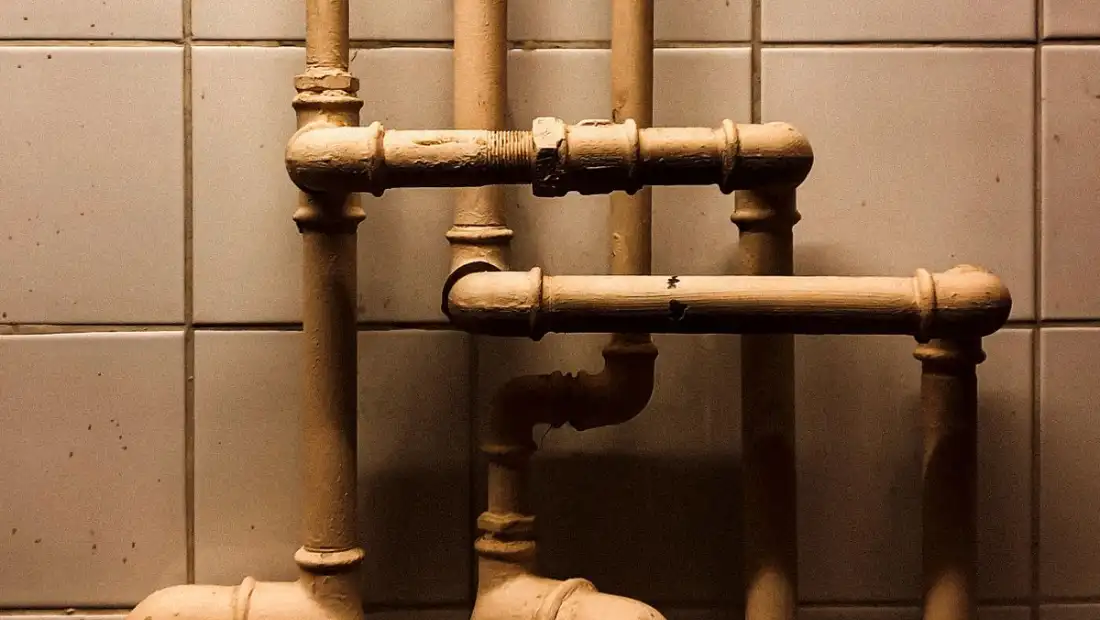
Insulate exposed pipe in crawl spaces, garages, attics and unheated basements. Foam sleeves are inexpensive; the important part is full coverage with taped joints, including elbows.
Seal air leaks near pipe runs. A cold draught through a rim joist penetration will freeze a pipe that insulation alone would have protected — wind matters more than air temperature.
Locate and label the main shut-off. Then have someone else in the house find it without your help. At 2 am in the dark this is not the moment for a search.
Service the furnace. The most reliable freeze protection any house has is a heating system that does not quit in a cold snap. See our heating service.
When a hard freeze is forecast
Open cabinet doors under sinks on exterior walls so room air reaches the pipes.
Let a vulnerable faucet drip — a pencil-lead stream from the cold side is sufficient. Moving water freezes far more slowly, and an open faucet prevents the pressure build-up described above.
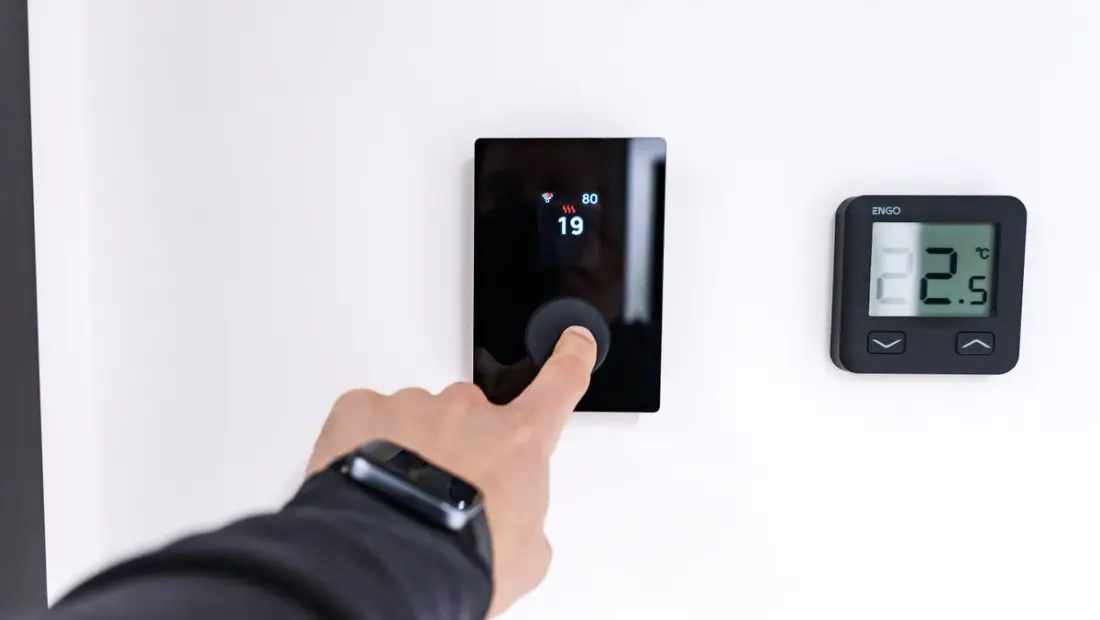
Keep the thermostat at a consistent temperature day and night. The overnight setback that saves money in November is a false economy at −5 °F.
If you are leaving for more than a couple of days, set the heat no lower than 55 °F and ask someone to check the house.
Open the garage door as little as possible where water lines run through it.
Leaving for an extended period?
For a vacancy of more than two or three weeks in winter, the reliable answer is to shut the main off and drain the system: open every faucet from the highest to the lowest, drain the water heater, and pour a little plumbing antifreeze into each trap. A thermostat set to 55 °F still fails if the furnace does.
How to tell a pipe is frozen before it bursts
The signs are quiet and easy to miss.
One fixture produces a trickle or nothing while the rest of the house is normal. That is the classic single-line freeze.
Frost or condensation on an accessible pipe. Look where the pipe leaves conditioned space.
Unusual noises when a tap is opened — banging, whistling or gurgling from a restricted passage.
A sewer smell. A frozen or frost-blocked vent stack stops the drain system venting, which can siphon traps dry.
Bulging or a visible bright split line on a pipe. That one is already past prevention — shut the water off.
Thawing a frozen pipe safely
If you have found the frozen section and the pipe has not split:
Open the faucet that pipe feeds, both handles. This is the step that prevents the burst. Leave it open throughout.
Apply gentle, even heat starting at the faucet end and working back toward the frozen section. Warming the far side first can trap meltwater behind ice and reproduce exactly the pressure you are trying to avoid.
Use a hair dryer, a heat lamp at a safe distance, warm towels, or a portable heater in the space. Be patient — thawing takes 30 to 60 minutes.
Keep watching for water as flow returns. A split may only reveal itself when pressure comes back.
Once flowing, leave the tap dripping until the outdoor temperature recovers.
Never use an open flame
No blowtorch, no propane heater aimed at a pipe. Every winter somebody sets a wall cavity alight thawing a pipe, and the fire costs far more than the plumber would have. Open flame also creates steam pockets inside the pipe that can rupture it outright. If you cannot reach the pipe safely, call us instead.
If a pipe has already burst: the first ten minutes
Shut the main water valve. Usually where the supply enters the basement or crawl space, or near the water heater. Turn clockwise until it stops.
Open the lowest faucet in the house to drain pressure and remaining water from the system.
Cut power to affected areas at the breaker panel if water is anywhere near outlets, fixtures or appliances. If reaching the panel means standing in water, do not — call the utility.
Switch off the water heater — gas valve to pilot, or breaker off for electric. An element firing in an empty tank destroys itself in minutes.
Photograph everything before you clean up. Your insurer will want it.
Call us on 785-776-5548. That number reaches the on-call technician at any hour.
Start removing water — towels, a wet vacuum, a fan. Mould can establish within 48 hours in a warm house.
What repairs cost, and what prevention costs
Item
Typical cost
When
Foam pipe insulation, whole crawl space
$60 – $180 in materials
Prevention
Frost-free hose bib replacement
$180 – $360 each
Prevention
Heat cable on a problem run
$180 – $420 installed
Prevention
Winterising a vacant property
$220 – $420
Prevention
Thawing a frozen line, business hours
$180 – $420
Response
Thawing, after hours
1.5× – 2× the above
Response
Repairing a single burst, accessible
$260 – $640
Repair
Burst inside a finished wall
$700 – $2,400
Repair, excluding drywall
Water damage remediation
$1,800 – $12,000+
Aftermath
The arithmetic is not subtle. An afternoon with foam sleeves and a caulk gun in October is the cheapest insurance available on a Kansas house.
If you would rather have it done properly, we winterise properties and insulate vulnerable runs throughout autumn. Call 785-776-5548 or see our plumbing services.
Need this done rather than read about it?
Henton Plumbing & Air Conditioning, Inc. has served Manhattan, Kansas since 1942. Call 785-776-5548 during office hours, or use the appointment form — weekday enquiries before 3 pm usually get a same-day reply.
A real tune-up is not a quick look and a sticker on the cabinet. Here is the twelve-point service every central system in the Flint Hills should get before June, and what each measurement actually tells you.
Three technologies, three very different ownership costs. We break down capacity, venting, recovery rates, installed price and the real-world lifespan we see in Riley and Pottawatomie counties.
Setback schedules, C-wires, two-stage equipment and heat-pump lockouts. A practical look at where the savings come from, and the wiring mistakes that cost people a compressor.
November 18, 202510 min read
Need a technician today?
Call the office before 3 pm on a weekday and we can usually be at your door the same day. After hours, the emergency line is answered by a real person.
We use a small number of cookies. They keep the site working and help us understand which pages people find useful. Read the Cookie Policy for the full list.