The 12-Point Spring AC Tune-Up Checklist Kansas Homeowners Should Insist On
11 min read Henton Plumbing & Air Conditioning, Inc.
A real tune-up is not a quick look and a sticker on the cabinet. Here is the twelve-point service every central system in the Flint Hills should get before June, and what each measurement actually tells you.
Why a spring service is not optional here
Air conditioning in the Flint Hills does not get an easy season. From mid-June the equipment runs close to its design capacity for weeks at a time, and anything marginal — a capacitor drifting out of tolerance, a coil half-blinded with cottonwood, a charge that is eight ounces light — is found out at the worst possible moment.
The blunt commercial reality is that the first 100 °F weekend fills every service schedule in Riley County. A system that failed on Friday afternoon might wait until Tuesday. The same fault, caught in April, is a routine visit with no wait and a much lower bill.
What follows is the twelve-point service we perform on a residential split system, and more importantly what each measurement tells us. If you use another contractor, this is a reasonable list to hold them to. If a “tune-up” consists of hosing the condenser and applying a sticker, you did not get one.
1. Filter and return air path
We start where most problems start. A restricted filter chokes airflow across the evaporator coil, which drops suction pressure, drops coil temperature and eventually freezes the coil solid. A frozen coil floods liquid refrigerant back to the compressor, and liquid does not compress.
We check the filter’s condition, confirm it is the right MERV rating for the equipment, and look at the return path as a whole. A house with one undersized return and every interior door closed is starving its air handler no matter how clean the filter is.
What MERV rating should you use?
MERV 8 to 11 suits most residential systems. Higher ratings capture more, but they also restrict more, and a MERV 13 filter in a system designed around MERV 8 can cost you enough airflow to matter. If you need better filtration, the right answer is usually a deeper media cabinet rather than a denser one-inch filter.
2. Static pressure across the system
This is the measurement most often skipped, and the one that explains the most. A manometer reads pressure before and after the air handler; the total external static pressure tells us whether the duct system can actually move the air the blower is trying to push.
Most residential equipment is rated at 0.5 inches of water column. We routinely measure 0.9 or higher in houses that have had filters upgraded, registers closed or rooms added without duct changes. Every increment above rating costs airflow, and lost airflow costs capacity, efficiency and compressor life.
Finding high static is not a sales opportunity — it is usually fixed by a different filter, an added return, or straightening a crushed flex run in the attic.
3. Evaporator coil condition
The indoor coil collects whatever the filter misses, and because it is wet during operation, that debris becomes a mat. We inspect it with a mirror and a light, and clean it where access allows.
A dirty evaporator behaves exactly like a dirty filter: low airflow, low suction pressure, poor dehumidification, and eventually ice. The difference is that nobody looks at it, so it degrades for years unnoticed.
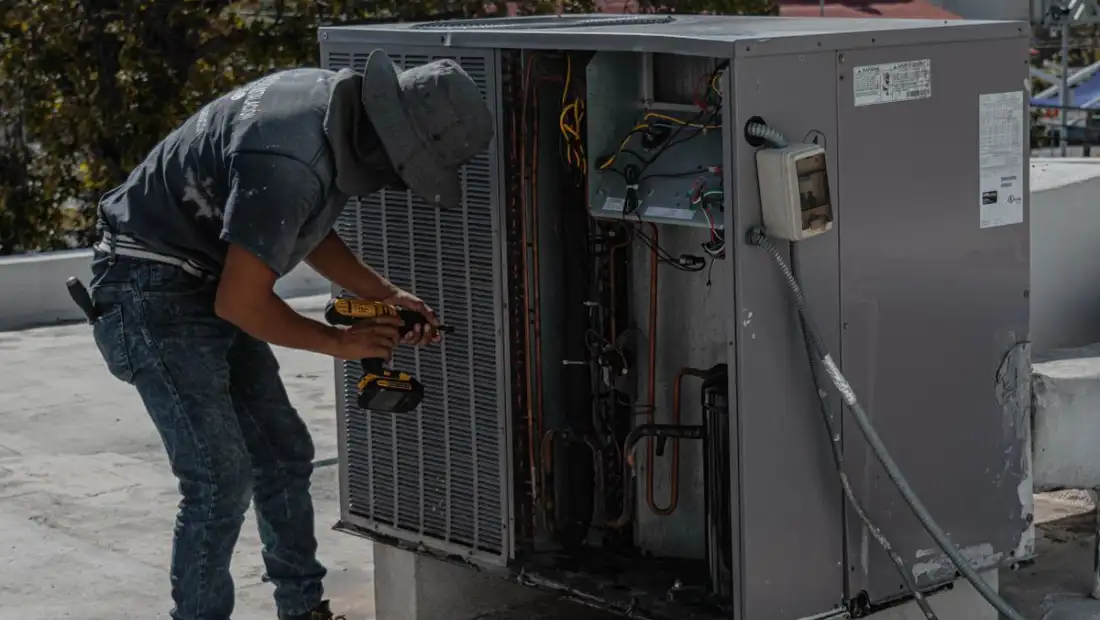
4. Condenser coil cleaning
The outdoor coil rejects heat, and it can only do that if air moves freely through the fins. In this part of Kansas the enemies are cottonwood seed in early summer, grass clippings from mowing, and dryer lint where a vent terminates nearby.
We clean from the inside out with a coil cleaner and low-pressure water, never a pressure washer. High-pressure water folds aluminium fins flat, and flattened fins block more air than the dirt did.
What you can do between visits
Keep two feet of clear space on all sides of the outdoor unit and five feet above it. Trim shrubs back, do not stack anything against it, and aim the mower discharge away. Rinsing the fins gently with a garden hose from the inside outward, with the power off at the disconnect, is safe and helpful.
5. Electrical connections and amp draw
Heat cycling loosens screw terminals over years, and a loose connection generates heat, which accelerates the loosening. We check and torque connections, inspect for discoloured or pitted contacts, and measure running amperage on the compressor and both motors.
Comparing measured amps to the rated load amps on the data plate tells us how hard the equipment is working. A compressor pulling near or above RLA on a mild day is a compressor with a problem — a failing bearing, a restriction, or a charge issue — and it will not survive August.
6. Capacitor testing
The run capacitor is the single most common failure part in residential air conditioning, and it is trivially cheap. It is also the part most often replaced unnecessarily, so we measure rather than guess.
A capacitor meter reads actual microfarads against the rating printed on the can, usually with a tolerance of ±6%. A 45 µF capacitor reading 38 is out of tolerance and will be replaced; one reading 44 is fine and we leave it alone. Bulging or leaking cans are replaced regardless of reading.
7. Contactor inspection
The contactor is the relay that switches line voltage to the compressor and condenser fan. Its contacts arc every time they close, and over several seasons they pit, then weld, then fail. A welded contactor means the outdoor unit never shuts off — something homeowners often mistake for a thermostat fault.
We pull the cover, inspect the contact faces, and check for the insects that are remarkably fond of nesting in contactor housings.
8. Refrigerant state: superheat and subcooling
Here is the point worth understanding: refrigerant is not consumed. A sealed system does not use it up the way an engine uses oil. If the charge is low, the system has a leak, and adding refrigerant without finding that leak is selling the same product twice.
We measure suction and liquid pressures, convert to saturation temperatures, and compare against actual line temperatures to calculate superheat and subcooling. Those two numbers, read together with the metering device type, tell us whether the charge is correct, low, high, or whether the problem is airflow rather than refrigerant at all.
Reading
Typical target
What an abnormal value suggests
Superheat (fixed orifice)
8–15 °F
High: low charge or a restriction. Low: overcharge or a flooding metering device.
Subcooling (TXV systems)
8–12 °F
Low: undercharge or a leak. High: overcharge or a restricted liquid line.
Temperature split
16–22 °F
Low: airflow or capacity problem. High: airflow starvation across the coil.
9. Blower wheel and motor
The blower wheel is a squirrel cage, and each of its curved blades is a small scoop. When dirt builds in those scoops the blade profile changes and the wheel simply stops moving as much air — 20 to 30 per cent is common on a neglected wheel, with no obvious symptom other than a house that will not cool.
We inspect the wheel, clean it where it can be reached, and check motor mounts and bearings. On ECM motors we verify the programmed airflow setting matches the equipment tonnage, because a setting left at the factory default on a replacement motor is a frequent cause of mysterious performance complaints.
10. Condensate drain and safety switch
A cooling coil produces a surprising volume of water — several gallons a day in humid weather. That water leaves through a drain line, and that line grows algae.
We clear the drain, flush the trap, and test the float safety switch that is supposed to shut the system down before water backs up into a ceiling. Testing matters: a safety switch that has never been checked is an assumption, not a safety device.
11. Thermostat calibration and staging
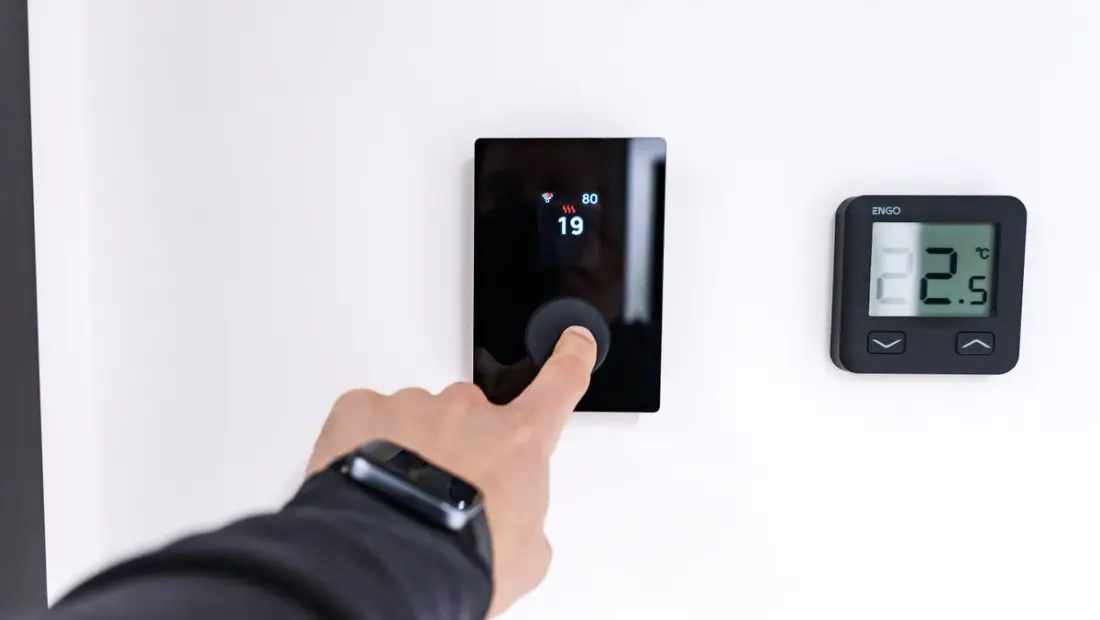
We verify that the thermostat reads actual room temperature, that the anticipator or cycle rate suits the equipment, and that staging is configured correctly on two-stage systems.
On heat pumps we pay particular attention to the auxiliary heat lockout. A thermostat that engages electric strip heat any time the heat pump has not satisfied within a few minutes will quietly triple a winter electricity bill. We cover this in detail in our smart thermostat guide.
12. Full-cycle operational test
Finally, we run the system through a complete cycle and re-measure: supply and return temperatures at the equipment, airflow, amp draw under steady-state load, and a listen for anything that changes under load but is silent at start-up.
You get a written record of the readings. Next spring, comparing those numbers year over year shows trends — a capacitor drifting down, a subcooling value slowly falling — long before they become a failure in July.
What a tune-up will not fix
Honesty about limits is part of the service. A precision tune-up does not compensate for equipment that was undersized or oversized at installation, a duct system that leaks 25 per cent of its air into an attic, or a compressor already on its way out.
What it does is keep a sound system operating at its designed capacity, catch cheap failures while they are still cheap, and give you the measurements to make a rational decision when replacement time comes.
Oversized equipment — short-cycles, never dehumidifies, cannot be tuned out. Only right-sized replacement fixes it.
Leaking ductwork — sealing and, where needed, resizing. Usually a separate project.
Undersized return air — needs an added return, not a different filter.
An old R-22 system — still serviceable, but refrigerant cost now drives most repair-versus-replace decisions.
Booking a service
We perform spring air conditioning services from March through May, and it is worth booking early — the schedule fills as soon as the first warm week arrives. Holders of our $119 Yearly Service Agreement get this service in spring and a matching furnace service in autumn, plus priority scheduling when everyone else is waiting.
Call 785-776-5548 or use the appointment form. If you would rather talk it over first, ask for whoever is at the service desk — they do this work too.
Need this done rather than read about it?
Henton Plumbing & Air Conditioning, Inc. has served Manhattan, Kansas since 1942. Call 785-776-5548 during office hours, or use the appointment form — weekday enquiries before 3 pm usually get a same-day reply.
Three technologies, three very different ownership costs. We break down capacity, venting, recovery rates, installed price and the real-world lifespan we see in Riley and Pottawatomie counties.
Pipes rarely split where the ice forms. Understanding that one fact changes how you protect a house — and what you do in the first ten minutes after a line freezes.
Setback schedules, C-wires, two-stage equipment and heat-pump lockouts. A practical look at where the savings come from, and the wiring mistakes that cost people a compressor.
November 18, 202510 min read
Need a technician today?
Call the office before 3 pm on a weekday and we can usually be at your door the same day. After hours, the emergency line is answered by a real person.
We use a small number of cookies. They keep the site working and help us understand which pages people find useful. Read the Cookie Policy for the full list.