Why Drains Clog: Six Causes, Six Fixes, and the Ones Worth a Camera
11 min read Henton Plumbing & Air Conditioning, Inc.
Grease, hair, roots, bellied pipe, flushable wipes and venting faults all look the same from the sink. Telling them apart is what decides between a twenty-minute cable job and an excavation.
Same symptom, six different causes
From the sink, every blockage looks identical: water that will not go down. From inside the pipe they could not be more different, and the difference decides whether you need twenty minutes with a cable or a section of pipe replaced.
This article walks through the six causes we actually find in Manhattan-area homes, how to recognise each from the symptoms, what fixes it, and which ones justify putting a camera down the line before spending money.
Cause 1: Grease
Where: kitchen lines almost exclusively. Symptoms: a gradual slowing over weeks or months, often noticeably worse after a holiday. Standing water drains eventually, then one day does not.
Cooking fats go down the drain as warm liquid and cool within a few feet of pipe. They congeal on the pipe wall and build inward, layer on layer, until the bore is a fraction of its original diameter. Detergent and hot water push the problem further down the line rather than removing it.
What actually works
Cabling a grease blockage bores a hole through the deposit. Water flows again, you are satisfied, and the remaining grease closes that hole within weeks. Hydro-jetting is the correct treatment: high-pressure water scours the full inner diameter back to bare pipe.
Prevention that genuinely works
Pour cooled fat into a jar and bin it. Wipe greasy pans with kitchen paper before washing. Run cold water, not hot, with a garbage disposal — cold keeps fats solid so they are carried away rather than coating the pipe downstream.
Cause 2: Hair and soap scum
Where: bathroom sinks, tubs and showers. Symptoms: slow draining that worsens steadily; often a visible mass just below the stopper.
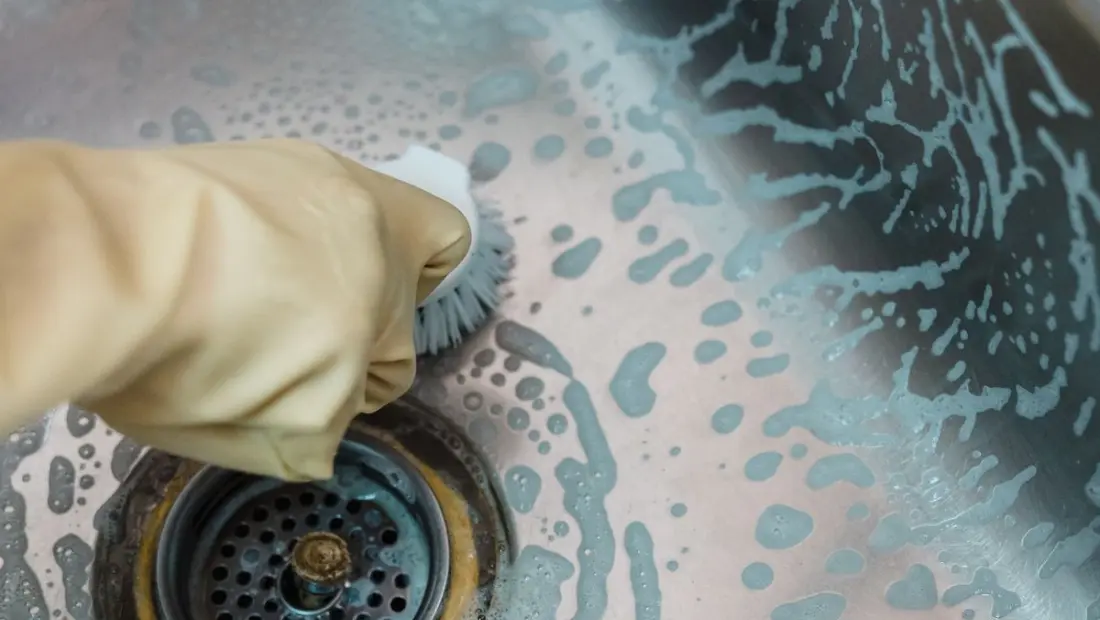
Hair catches on the stopper mechanism and the crossbars of the strainer, and soap scum binds it into a mat. It is the most common household blockage and the easiest to deal with.
What works
Remove the stopper and clear the visible mass by hand. Unpleasant, effective, free.
A plastic barbed drain tool will reach a foot or two further.
If neither works, the blockage is past the trap and needs cabling.
Fit a hair catcher afterwards. It is the single best return on a few dollars in plumbing.
Hair blockages essentially never affect the main line. If a tub is slow and a toilet is gurgling, you are looking at a different problem entirely — keep reading.
Cause 3: Tree roots
Where: the main sewer lateral, outdoors, usually 10 to 60 feet from the house. Symptoms: repeating blockages on a roughly seasonal cycle, gurgling toilets, multiple fixtures slow at once, and sometimes a backup at the lowest drain in the house — typically a basement floor drain.
Roots seek moisture and nutrients, and a sewer lateral offers both. They enter through joints in clay or cast iron pipe, or through cracks, and once inside they grow into a mass that catches everything passing.
What works, and what does not
Mechanical cutting with a root-cutting head clears the mass and restores flow. Hydro-jetting does a more thorough job and flushes the debris out. A root-inhibiting treatment slows regrowth.
None of that closes the opening the roots came through. If a line has roots, it will have roots again — typically in 18 to 24 months. Permanent resolution means repairing or lining that section. That is a real expense, which is precisely why it is worth seeing the joint on camera before deciding.
Cause 4: A bellied or offset pipe
Where: anywhere in the underground lateral. Symptoms: blockages recurring at the same measured distance every time, no seasonal pattern, and a line that clears easily but blocks again within months.
A belly is a section of pipe that has sagged below grade, usually from soil settlement or poor bedding at installation. Water pools in the low spot instead of flowing through, solids drop out of suspension, and the sag gradually fills.
An offset is a joint where two sections no longer align, leaving a lip that catches debris. Both are structural.
What works
Nothing that does not involve pipe. Cleaning restores flow temporarily — a belly refills, every time. A camera with a locator tells us exactly where it sits and how deep, so any excavation is a targeted dig rather than a trench across the garden.
A warning about repeat cleaning
If you are paying somebody two or three times a year to clear the same line and nobody has put a camera in it, you are funding a symptom. Ask for the inspection. A one-off camera fee is less than two more cleanings.
Cause 5: Wipes and other non-flushables
Where: toilet branches and the main line. Symptoms: sudden and total. No gradual slowing — it worked yesterday and today nothing moves.
“Flushable” wipes are flushable in the sense that they leave the bowl. They do not disintegrate the way toilet paper does; they stay intact, catch on any irregularity, and knit together with grease into a solid, fibrous mass. Municipal treatment plants nationally spend a great deal of money on this exact problem.
The list of things that are not flushable
Wipes of every description, however they are labelled
Paper towels, tissues and cotton wool
Feminine hygiene products
Dental floss — it does not break down and it binds other debris together
Cat litter, even the “flushable” kind
Medication (take it to a pharmacy take-back)
Cooking grease
Cause 6: A blocked vent
Where: the vent stack, usually at or near the roof. Symptoms: gurgling from one fixture when another drains; traps that dry out and let sewer smell into a room; drains that run slowly despite being clear.
This one is counter-intuitive, because the drain is not blocked at all. Every drainage system needs air. When water leaves a fixture, air must enter behind it, and that air comes through the vent stack to the roof.
If the stack is blocked — a bird’s nest, leaves, or in Kansas most often frost closure during an extended cold snap — the system takes its air through the nearest available opening instead, which is the water seal in another fixture’s trap. That is the gurgle. Do it often enough and the trap siphons dry, and sewer gas has an open path into the room.
What works
Clearing the vent, usually from the roof. Frost closure will recur each winter on a stack that is undersized where it passes through the roof; the permanent fix is increasing that section’s diameter so a rime of ice cannot close it.
How we decide what to do
What we see
Most likely cause
First action
One fixture slow, others fine
Local blockage: hair, grease, debris
Clear the trap, then cable the branch
Kitchen line only, gradual onset
Grease
Jet rather than cable
Several fixtures slow, gurgling
Main line or venting
Cable the main through a cleanout; check the vent
Basement floor drain backing up
Main line blockage downstream
Cable the main; then camera
Repeats seasonally
Roots
Cut and jet, then camera to find the joint
Repeats at the same distance
Belly or offset
Camera with locator; plan a repair
Sudden total blockage
Foreign object or wipes
Cable with a retrieval head
On chemical drain cleaners
We would rather you did not. The reasons are practical, not precious.
They work by generating heat and attacking organic matter. Against a full blockage they sit on top of it and do very little.
That heat can distort PVC and soften joints, and caustic products pit older metal traps and corrode cast iron.
They rarely clear a real blockage, so a technician still has to open the trap — now full of caustic liquid, which is a genuine hazard.
Repeated use degrades the pipe you are trying to keep.
If you have already used one, please tell us when you call. It changes how we approach the job, and we would rather know than find out.
Better alternatives: a plunger used properly with the overflow blocked, a drain auger for a branch line, or boiling water and dish soap for a mild grease slow-down in a metal pipe. For anything beyond that, see our drain and sewer service or call 785-776-5548.
Need this done rather than read about it?
Henton Plumbing & Air Conditioning, Inc. has served Manhattan, Kansas since 1942. Call 785-776-5548 during office hours, or use the appointment form — weekday enquiries before 3 pm usually get a same-day reply.
A real tune-up is not a quick look and a sticker on the cabinet. Here is the twelve-point service every central system in the Flint Hills should get before June, and what each measurement actually tells you.
Three technologies, three very different ownership costs. We break down capacity, venting, recovery rates, installed price and the real-world lifespan we see in Riley and Pottawatomie counties.
Pipes rarely split where the ice forms. Understanding that one fact changes how you protect a house — and what you do in the first ten minutes after a line freezes.
January 9, 202612 min read
Need a technician today?
Call the office before 3 pm on a weekday and we can usually be at your door the same day. After hours, the emergency line is answered by a real person.
We use a small number of cookies. They keep the site working and help us understand which pages people find useful. Read the Cookie Policy for the full list.